
Raw Humalite, Magna Granular or Liquid Humic Acid: Which Fits Your Farm?
Humic products are not all the same. Raw humalite, processed granular humic and liquid humic acid differ in how they are handled, how they interact with soil and fertilizer, and where they can be placed in a cropping system. Choosing the right form matters more than simply picking the largest humic percentage on a label.
Our preferred starting point for many Peace Country broadacre farms is Magna granular humic acid. Of the humic forms we’ve worked with, Magna has produced some of our strongest observed field responses so far. That experience is why we often discuss it first—while still recognizing that raw humalite and liquid humic each have a place.
Three humic forms, three different agronomic roles

Raw Humalite
Bulk soil amendment. A source material for humic substances, suited to longer-term, soil-directed programs.

Magna Granular Humic
Our preferred starting point. Processed humic granules that suit compatible dry fertility and root-zone programs.

Liquid Humic Acid
Targeted liquid application. An option for compatible in-furrow, soil-directed or foliar programs.
Why we favour Magna granular humic acid
Black Earth humiZEN Magna is processed from Alberta humalite into a partially soluble granule. The manufacturer lists approximately 60% water solubility and 50% humic substances measured by ISO 19822/CDFA methods. It combines a soluble portion with less-soluble humic material, rather than being simply raw humalite.
The agronomic reason we’re interested in Magna is root-zone placement. When a compatible dry fertility system can place humic substances near developing roots and fertilizer, those substances may influence nutrient interactions, trace-element complexing and early root development. That is a more targeted approach than assuming a small quantity of amendment will change the chemistry of an entire field.
- Close to the crop: compatible dry fertilizer or banded placement puts humic material in the part of the soil the young crop is using.
- Partially soluble: a processed product with a soluble fraction, rather than relying solely on raw material.
- Works with dry programs: can fit appropriate granular fertilizer, drill or strip-till systems after checking flow, placement and compatibility.
- Promising on-farm experience: Magna has delivered some of our most encouraging visible field responses to date.
That does not mean Magna guarantees a yield increase or that every field needs humics. Fertility balance, moisture, crop, product rate and fertilizer placement still determine whether a response is likely. Follow current label guidance and confirm seed-row safety before in-furrow use.
What we’ve seen in barley
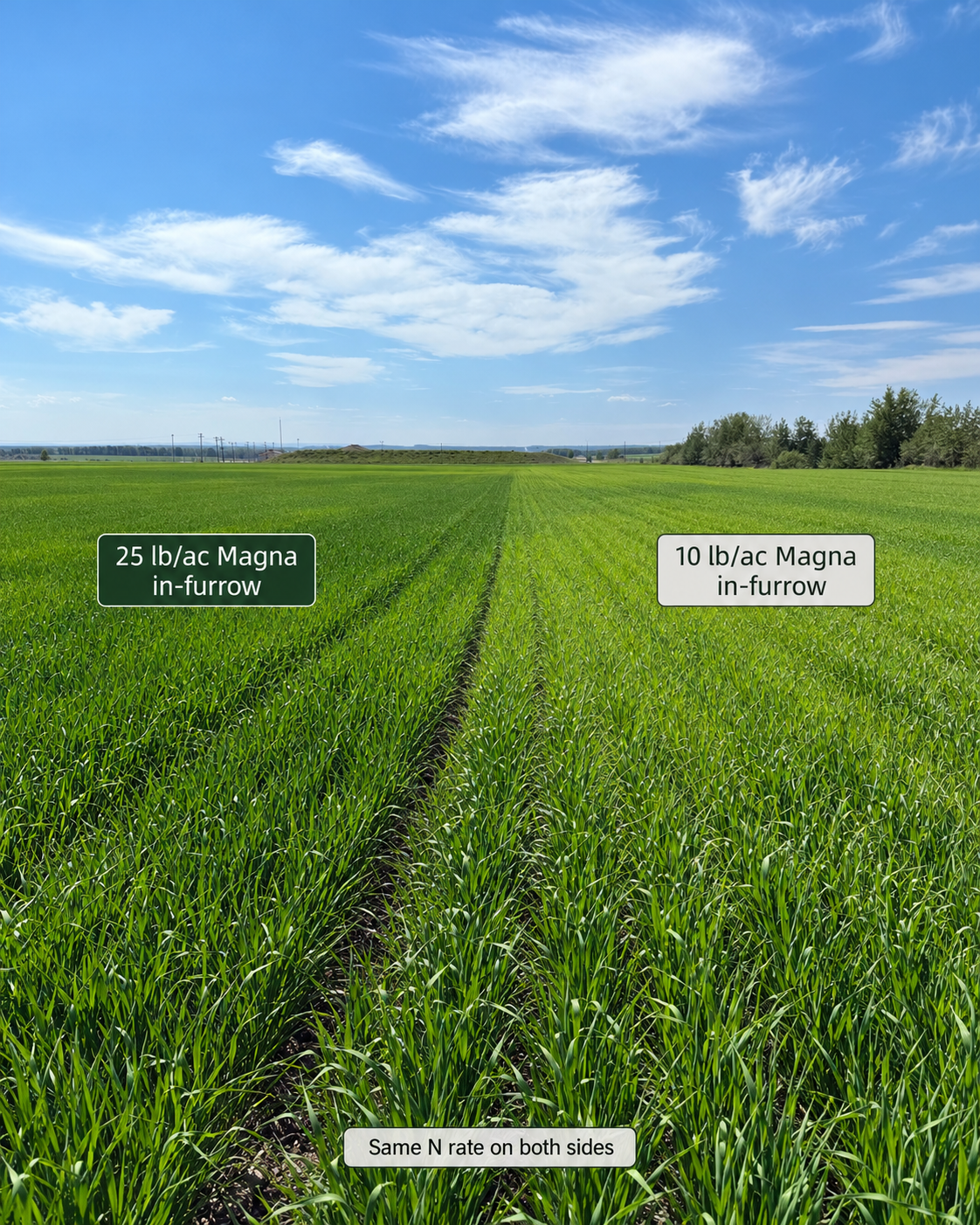
This comparison is one reason Magna has our attention. The grower also reported a positive Brix and yield response in the higher-rate area. It is useful field experience, but other conditions and uncontrolled differences can influence results; we would not present the reported gain as an expected result for another farm. The next step is to keep validating where and when Magna earns its place.
Interested in Magna? See our Magna Granular Humic Acid product page for the analysis, manufacturer-published application guidance and more detail on the barley comparison.
Where raw humalite fits
Raw humalite is naturally occurring oxidized lignite containing humic substances. It is the starting material for many processed humic products, but it should not be treated as equivalent to Magna or a liquid concentrate.
Its agronomic role is generally a broader, longer-term soil amendment program. Humic substances can interact with nutrient ions and organic matter in the soil, but the practical response from bulk raw material depends on grade, particle size, conditions and incorporation. A raw amendment may make sense when the objective is soil-directed improvement on a larger scale rather than a targeted low-rate root-zone application.
Raw humalite is not our automatic first choice when a grower wants a precise seed-zone humic application. For bulk supply and how it could fit a soil program, visit our Alberta humalite and humic acid page.
Where liquid humic acid fits
Liquid humic formulations are useful when the agronomic goal is to place a compatible product through an application pass the farm already makes. They can deliver humic substances in a liquid carrier in soil-directed or permitted foliar programs, with the opportunity to target timing and placement.
The formulation matters. humiZEN Alpha is designed with broader liquid-fertilizer compatibility in mind; Liquid Carbon 12% and Liquid Carbon HC 24% are higher-pH products with different mixing restrictions. A humic percentage obtained by the colourimetric method is not directly comparable to an ISO 19822 value. Tank-mix compatibility, fertilizer concentration, water quality and product labels should guide the choice.
Liquid humic can be a strong fit for a well-designed liquid system. We simply prefer Magna as the first discussion for many growers using dry fertility systems, based on the field responses we’ve seen. Explore the liquid humic acid product options if your program is built around liquids.
Our recommendation for Peace Country farms
Start by considering Magna when you’re looking to include humic substances close to the root zone in a suitable dry fertilizer program. It is the product we’ve been most encouraged by in our own field observations, and it is often the first granular humic option we’ll discuss.
Consider raw humalite when the objective is a wider, longer-term soil amendment program. Consider liquid humic when your cropping system already has a compatible liquid application and the formulation suits your fertilizer or spray program. No single form is automatically best for every field.
Tell us your crop, soil conditions and how you apply fertilizer. We can explain why we favour Magna, review the alternatives and help you choose a product that makes agronomic sense for your farm in Northwestern Alberta or Northeast BC.
Ask About Magna & Humic Options Or call 780-380-1408.
Product details: Magna Granular · Raw Humalite · Liquid Humic Acid · Fulvic Acid.