
PhycoTerra: Feeding the Biology Already in Your Soil
A living soil contains an enormous community of bacteria, fungi and other organisms. Many of those organisms depend on organic carbon and other nutrients to remain active. Improving biological function is not only a question of adding more microbes; it also means understanding what feeds the organisms already present.
PhycoTerra is a microalgae-based microbial food designed around that principle. Rather than introducing a new microbial inoculum, it supplies organic compounds intended to support native microbial communities and the processes they perform.
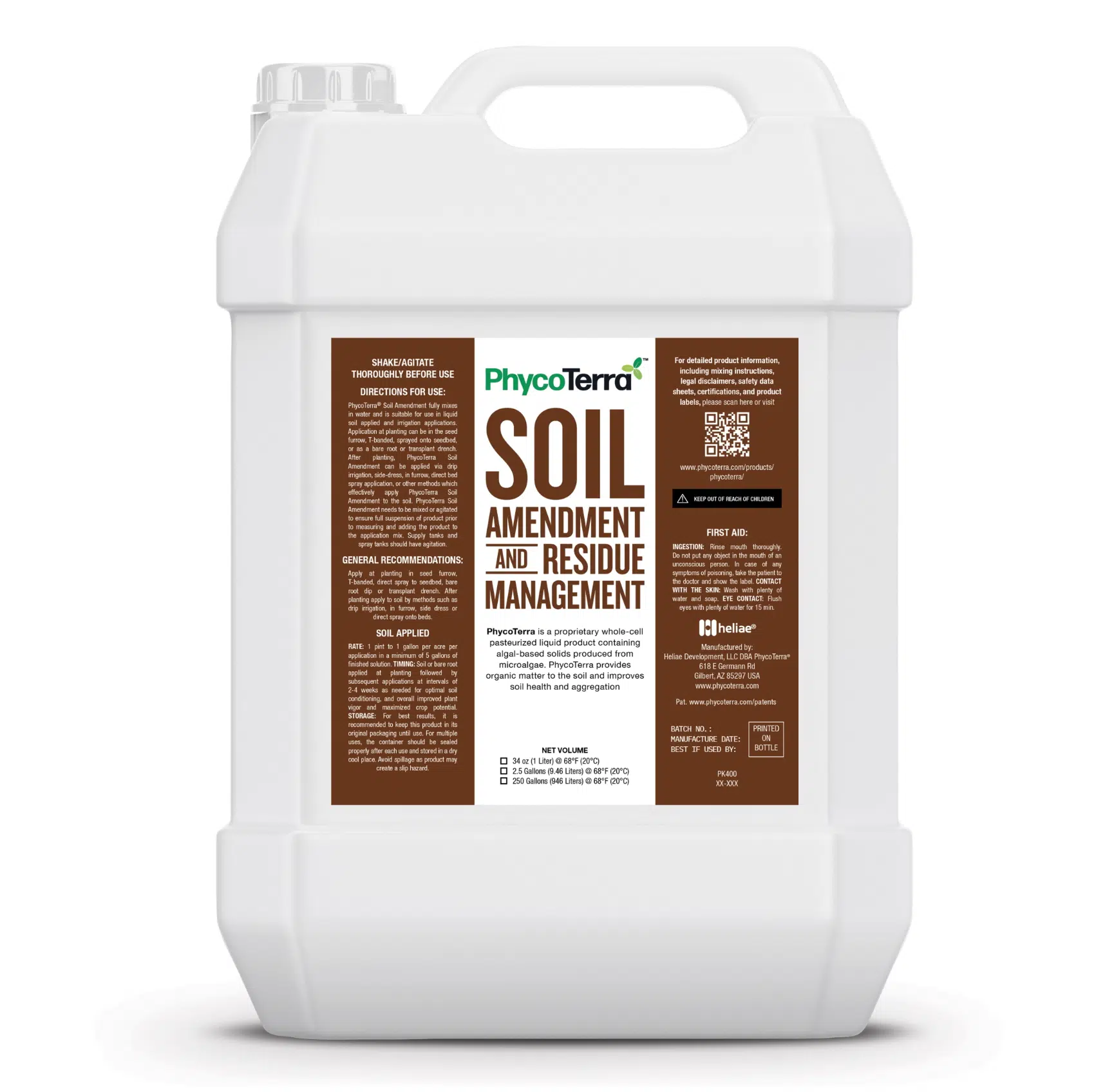
Feeding soil life instead of introducing new organisms
Soil microbes participate in residue decomposition, nutrient transformations and the development of organic compounds that influence soil aggregation. Yet the availability of food sources can limit how active those communities are, even when organisms are already present.
PhycoTerra uses a microalgae-derived formulation containing a mixture of organic compounds. The manufacturer’s stated objective is to nourish a range of native bacteria and fungi rather than rely on one organism or one source of simple sugar.
This distinction matters in a biological fertility program. A microbial inoculant introduces organisms. A microbial food supplies resources intended to support existing organisms. These approaches are complementary in concept, but they are not automatically interchangeable or additive in their field effects.
Why microalgae are an interesting food source
PhycoTerra’s manufacturer describes a balanced blend of carbohydrates, proteins and lipids from microalgae. It reports a carbon-to-nitrogen ratio of approximately 7:1 for its standard soil microbial food formulation. The balance of carbon and nitrogen matters because microbial growth requires both energy and nutrients.
A relatively low C:N ratio may reduce the risk of strong temporary nitrogen immobilization compared with some high-carbon residues, although the response still depends on the amount applied and the existing soil environment. The product is best understood as a biological food source, not a substitute for a crop’s nitrogen requirement.
Review PhycoTerra’s explanation of its microalgae formulation and microbial food concept.
The connection between microbial activity and soil structure
Soil structure develops through interactions among minerals, roots, fungal networks, organic compounds and microbial communities. Microorganisms can contribute to aggregation through the compounds they produce and the way they interact with soil particles.
PhycoTerra promotes research and field observations linking its microbial food approach with biological activity, nutrient availability, water retention and soil physical properties. These are important areas to examine, but a single application does not guarantee improved aggregation, greater organic matter or additional water-holding capacity. Those outcomes depend on soil texture, management and conditions over time.
The difference between PhycoTerra, EcoTea and kelp
The products have different biological objectives. PhycoTerra is intended to feed native soil microorganisms. EcoTea provides broad-spectrum microbial inoculants for seed, root-zone and residue applications. Kelpivex supplies seaweed-derived compounds intended primarily to influence plant processes such as root growth and stress responses.
A soil-health program does not necessarily need all three. The right approach depends on what is limiting biological function in a given field and whether an application can be evaluated against a useful control.
Where PhycoTerra fits in a field program
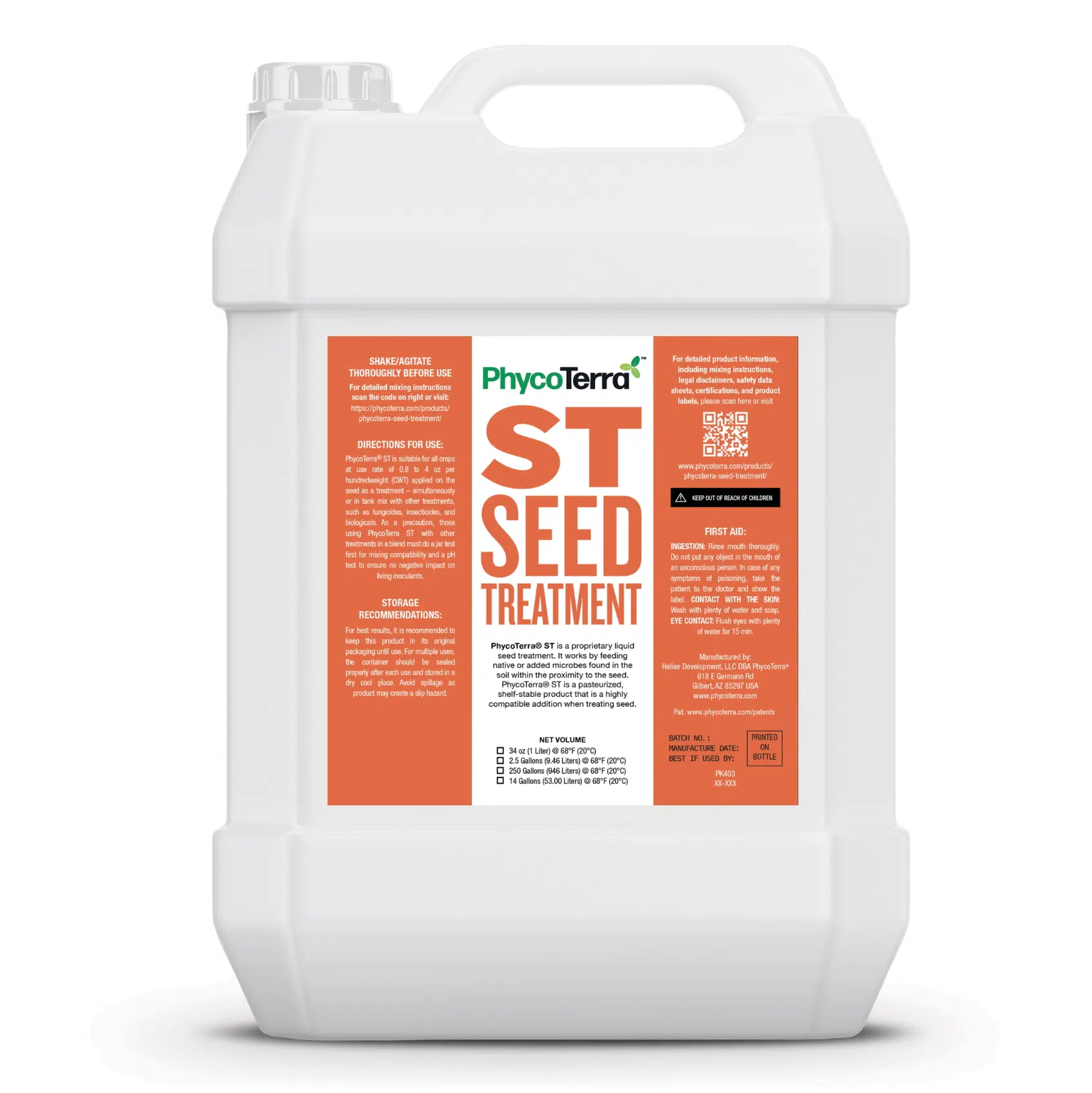
The manufacturer offers soil, seed-treatment and foliar microbial-food formulations, with product-specific directions. For broadacre crops we would start by identifying the objective—supporting the root-zone microbiome, investigating emergence or evaluating a foliar biological program—and then select the appropriate formulation.
Application rates, handling and tank mixes must follow the current Canadian label for the exact product. Crop protection compatibility should be evaluated rather than assumed, and soil conditions still determine much of the microbial response.
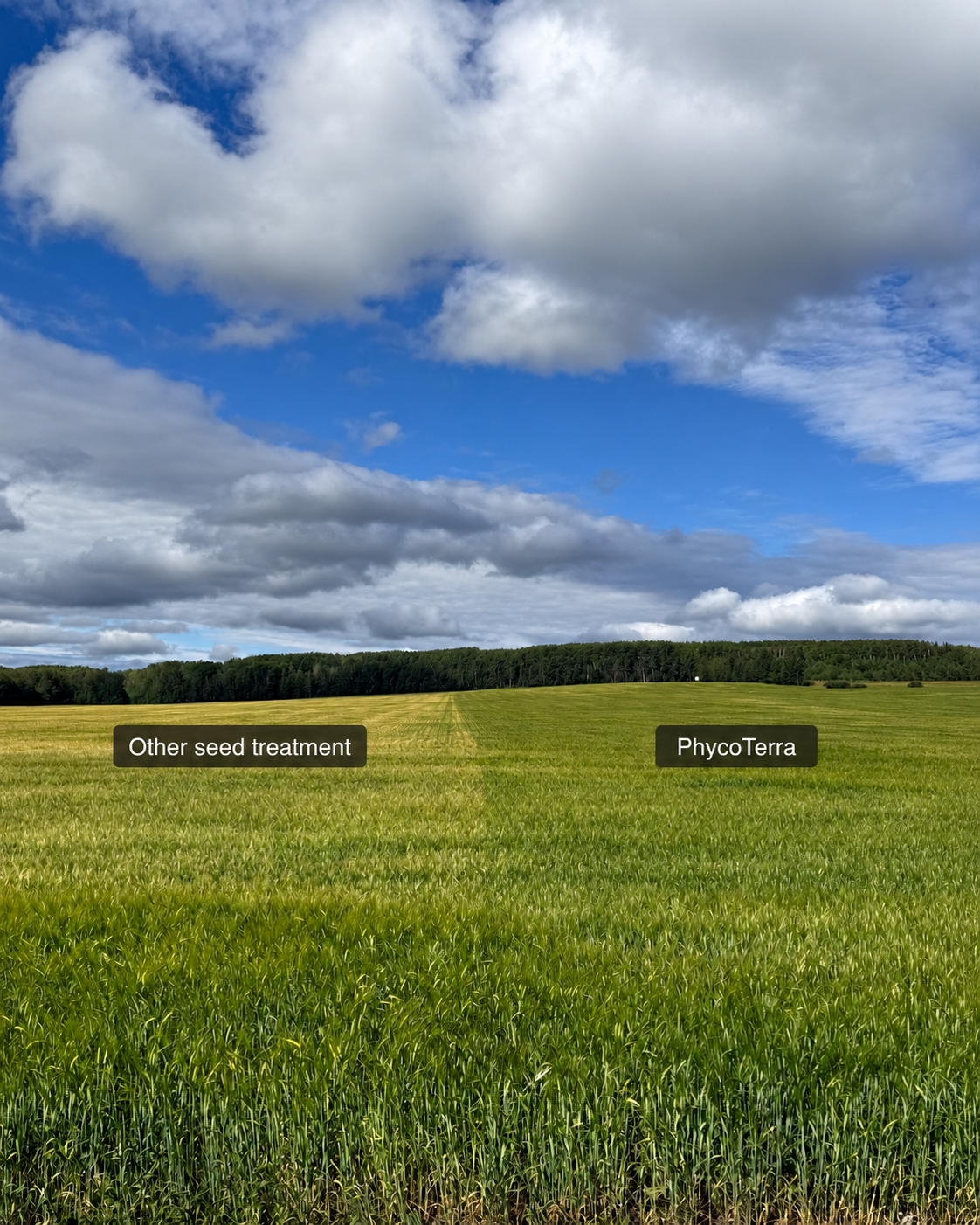
On-Farm Comparison: PhycoTerra and Another Seed Treatment
In a commercial field comparison, a grower evaluated PhycoTerra against a different seed-treatment program. The PhycoTerra side was on the right of the field photograph, with a visible difference in crop colour and canopy development compared with the other treatment on the left.
The grower checked plant Brix and found higher readings on the PhycoTerra side. At harvest, he reported 10–12 bu/ac more yield from that treatment. Seeing a crop difference during the season is interesting. Hearing that it carried through to harvest makes it worth a much closer look.
I like comparisons like this because we can follow what we see in the crop through to harvest. The grower’s Brix readings and yield results give us a practical reason to keep testing PhycoTerra in the field.
Why this result is interesting
PhycoTerra is a food source for the microbial communities already living in the soil. Rather than adding another large dose of N, P or K, the goal is to support the biology that helps cycle nutrients and interact with roots. That’s why this result is worth exploring.
Measuring changes in biology
If we want to know whether feeding native microbes is worthwhile, we should measure more than a yield comparison alone. Biological soil tests, potentially mineralizable nitrogen, residue cycling indicators and soil aggregation can provide useful context alongside plant growth and harvest results.
Repeatable comparisons, taken at similar soil temperatures and sampling conditions, are more informative than a single isolated test. Our objective at Peace Soil Works is to build the soil’s ability to cycle nutrients and support crop growth over the long term, while remaining realistic about what one biological input can achieve.
Further reading and local guidance
PhycoTerra Soil Amendment technical information, Canadian label and application resources · PhycoTerra product range · Biostimulants & Seed Treatments overview.
To explore PhycoTerra as part of a soil-health strategy, contact Peace Soil Works. We can discuss the field, the products already in use and how to evaluate results.